
Why does anxiety keep coming back? Understanding the anxiety cycle
Most people experience anxiety from time to time. It can be a useful response to situations that feel uncertain, challenging or threatening. But sometimes anxiety can start to feel as though it is happening repeatedly, even when you know that the situation isn't as dangerous as it feels.
You might find yourself worrying about the same things over and over again, avoiding situations that make you anxious, checking for signs that something is wrong, or looking for reassurance from other people. You may have periods where you feel much better, only to find that the anxiety returns.
If this sounds familiar, you might wonder: why does my anxiety keep coming back?
One reason is that some of the things we naturally do to reduce anxiety can unintentionally keep the anxiety cycle going.
Understanding the anxiety cycle
When we feel anxious, our brain and body respond as though we are facing a threat. You might notice physical sensations such as a racing heart, feeling shaky, tightness in your chest, dizziness or a feeling of being on edge.
At the same time, your thoughts may become focused on what could go wrong.
For example:
Situation: You have to give a presentation at work.
Thought: "I'm going to make a mistake and everyone will think I'm incompetent."
Physical sensations: Your heart starts racing and you feel tense.
Emotion: Anxiety increases.
Behaviour: You might avoid looking at people, rush through the presentation, repeatedly practise what you are going to say or consider calling in sick.
These responses can make sense when you're feeling threatened. The difficulty is that they can sometimes reinforce the belief that the situation really was dangerous.
This creates a cycle:
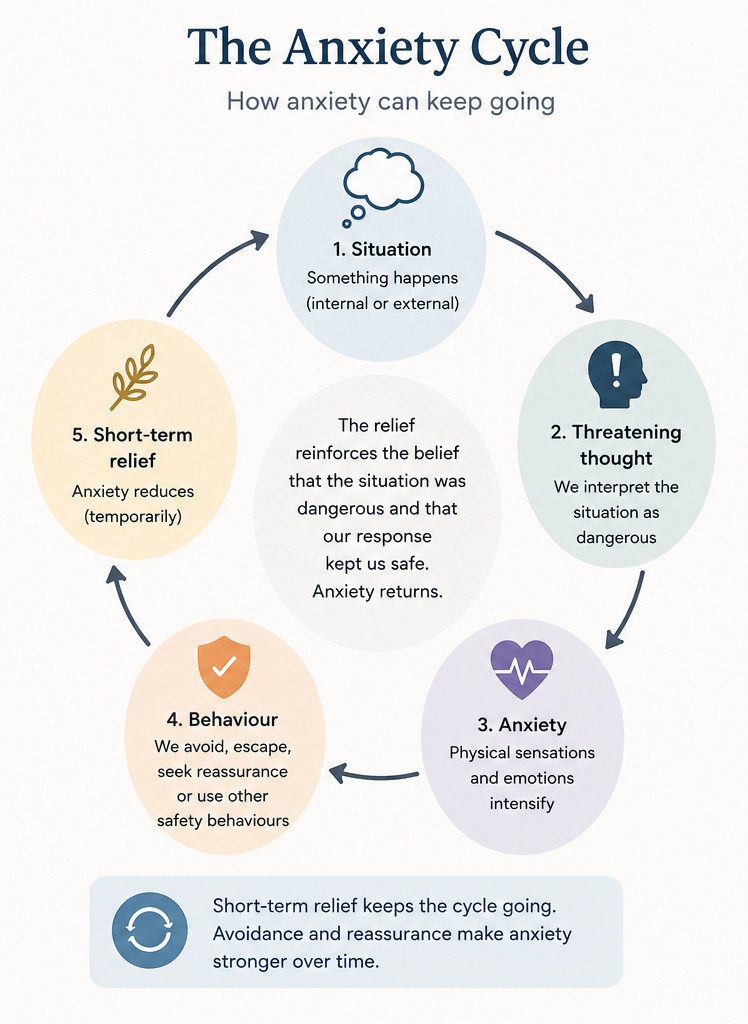
Understanding this cycle can be an important first step towards changing it.
Why does avoiding anxiety make it stronger?
Avoidance is one of the most understandable responses to anxiety.
If something makes you anxious, avoiding it can provide immediate relief. If you're frightened of driving, for example, deciding not to drive might make you feel calmer. If social situations make you anxious, staying home can temporarily remove the uncomfortable feelings.
The problem is that avoidance doesn't give you the opportunity to discover what might actually happen if you stayed in the situation.
Instead, your brain may learn:
"I felt anxious, I avoided the situation, and then I felt better. Avoiding it must have kept me safe."
The cycle can become:

This can make the situation feel even more threatening next time. Over time, your world can gradually become smaller as you avoid more situations or activities.
What about reassurance and checking?
Avoidance isn't the only behaviour that can maintain anxiety.
You might repeatedly ask someone to reassure you that everything will be okay, check your body for signs of illness, search online for information, repeatedly check something you've done, or mentally go over a situation to make sure you haven't made a mistake.
These behaviours can also reduce anxiety temporarily.
For example, if you're worried that you've made a mistake at work, asking a colleague whether everything is okay might make you feel better for a while. But if the worry returns later, you may feel that you need reassurance again.
The cycle can become:

This doesn't mean that checking or seeking reassurance is "wrong". These behaviours are often attempts to cope with anxiety and feel safe.
The problem is when you become increasingly dependent on them to feel okay.
Why does anxiety sometimes come back even when you've been feeling better?
It is normal for anxiety to fluctuate.
You might have made significant progress and then experience a stressful period, face a situation that reminds you of a previous difficulty, or notice an old anxious thought returning.
This doesn't necessarily mean that you've gone back to where you started.
Progress with anxiety isn't usually about never feeling anxious again. Instead, it can involve becoming more confident in responding differently when anxiety does appear.
For example, you might notice an anxious thought without immediately trying to eliminate it. You might stay in a situation that makes you uncomfortable rather than automatically avoiding it. Or you might resist the urge to seek reassurance.
These changes can help you learn that anxiety can rise and fall without you needing to respond to it in the same way.
So how can CBT help?
Cognitive Behavioural Therapy (CBT) looks at the relationship between your thoughts, feelings, physical sensations and behaviours.
Rather than simply trying to make anxiety disappear, CBT can help you understand what is keeping your anxiety going and identify opportunities to respond differently.
Depending on the type of anxiety you're experiencing, this might involve:
identifying patterns of anxious thinking
understanding and reducing avoidance
reducing behaviours such as checking or reassurance-seeking
learning to tolerate uncertainty
gradually facing situations you have been avoiding
developing different ways of responding to physical sensations
changing patterns of self-criticism or threat-focused attention
The specific approach will depend on your individual difficulties and what you want to change.
You don't have to wait until you feel confident
One of the most common misconceptions about anxiety is that you need to feel confident before you can start doing the things that anxiety has been stopping you from doing.
In reality, confidence often develops after you begin responding differently.
You may feel anxious while doing something you've been avoiding. That doesn't mean you're doing it wrong.
The aim isn't necessarily to make anxiety disappear before you act. It can be about learning that you can experience anxiety and still choose what you want to do.
Over time, this can help break the cycle.
When might therapy be helpful?
Anxiety can become a problem when it starts to interfere with the things that matter to you — your work, relationships, social life, health, sleep or everyday activities.
You don't need to have completely lost control of your life before seeking support.
If you find yourself repeatedly avoiding situations, seeking reassurance, checking, worrying or changing your behaviour because of anxiety, it may be worth exploring what is keeping the cycle going.
CBT can provide a structured way of understanding these patterns and working towards meaningful changes.
Take the first step
If anxiety is affecting your everyday life, you don't have to work out how to change these patterns on your own.
I offer CBT for anxiety in Guildford, Godalming and Farnham, as well as online therapy for adults throughout the UK.
If you'd like to find out whether therapy with me could be helpful, you can book a free 15-minute initial consultation.

Comments